
The IRS Wants More of Your Land Sale Than You Think—A DST Can Help You Keep It
For landowners considering a sale, DSTs may provide tax deferral, potential income distributions, diversification, and a simpler path for future estate planning
For many landowners, the farm, ranch, or acreage isn’t just a piece of property—it’s the result of decades of sweat, sacrifice, and smart stewardship. But when it comes time to sell, the tax bill can shock even the most prepared.
When land has a low basis (meaning it was bought years ago for much less than its current value), selling can trigger multiple layers of taxes—federal, state, and sometimes even local. Add them all together, and you could lose 20% to 35% or more of your proceeds before you ever see the money.
This article explains the main taxes that can hit when selling highly appreciated land—and how strategies like 1031 exchanges and Delaware Statutory Trusts (DSTs) may help manage them.
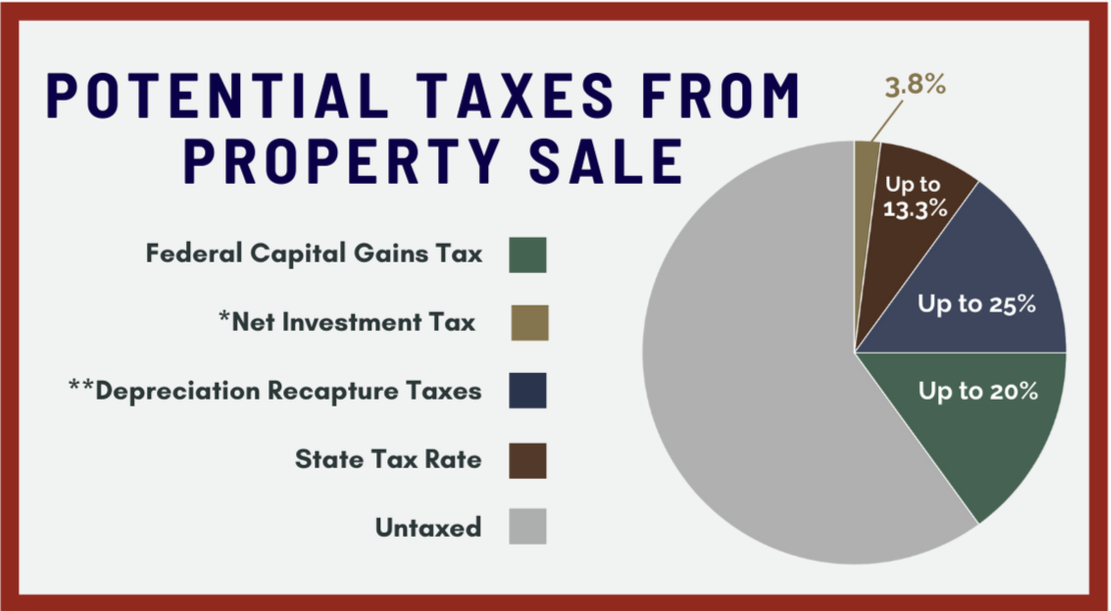
Important Note: The following example graph is for illustration only. Always consult with your own tax, legal, and accounting advisors before making any decisions.
* Applies to investment income exceeding $200,000 for single filers, $250,000 for those married filing jointly.
**Applies to the depreciation taken during the ownership period.
What Is the Federal Capital Gains Tax on Land Sales?
The first tax most landowners think about is federal capital gains tax. If you sell appreciated property, the gain (sale price minus adjusted basis) is taxed at one of three federal rates:
15% for most sellers
20% for higher earners
23.8% if you’re also subject to the 3.8% Net Investment Income Tax (NIIT)
That extra 3.8% NIIT applies once adjusted gross income (AGI) exceeds $200,000 (single) or $250,000 (married filing jointly).
So depending on income level, many landowners face between 15% and 23.8% federal capital gains tax.
What Is Depreciation Recapture and Why Does It Matter?
This is one of the most misunderstood—and expensive—surprises.
Over time, many landowners take depreciation deductions for improvements, barns, irrigation pivots, grain bins, or equipment. When you sell, the IRS often wants some of that back.
Section 1250 Recapture – Applies to buildings or improvements. With a 1031 exchange (or DST), much of this can be deferred.
Section 1245 Recapture – Applies to equipment, vehicles, pivots, fencing, and other short-life assets depreciated over 3, 5, or 7 years. These amounts are usually not deferrable even with a 1031 exchange.
This recapture doesn’t get capital gains treatment—it’s taxed as ordinary income (see below).
How Does Depreciation Recapture Trigger Ordinary Income Tax?
Here’s where the bite can really hurt.
Any depreciation recapture under Section 1245 is taxed at your ordinary income rate, not at capital gains rates. Depending on your tax bracket, that could be as high as 37% federally.
For many landowners, this is the biggest surprise when they sell. You may think you’re facing a 15–20% capital gains bill, only to discover that a big portion of your sale is taxed as ordinary income.
What About State Taxes on Land Sales?
On top of federal taxes, most states impose their own income tax.
Oklahoma: 5%
California: Over 13%
Many others: Range from 3% to 9%
This means your total tax bill depends not only on federal rules but also on where your property is located and where you file your taxes. And unlike federal tax, there’s no preferential capital gains rate in some states—they simply treat the gain as ordinary income.
Could the Alternative Minimum Tax Apply?
For some landowners, the Alternative Minimum Tax (AMT) can apply—especially if you’ve taken large depreciation deductions in past years.
High-net-worth families may also face estate and gift tax considerations when transitioning property to heirs.
How Do Estate Taxes and the Step-Up in Basis Work?
Here’s where timing matters.
If land is passed to heirs at death, they generally receive a step-up in basis. This resets the property’s tax basis to its current fair market value, effectively wiping out the unrealized capital gains. Heirs start fresh, and the decades of appreciation are erased for tax purposes.
DSTs pass through estates the same way—interests can be divided among heirs, and each receives the same step-up in basis. This is why many families choose to defer taxes during life (using DSTs/1031s) and then allow the step-up to take care of the rest at death.
Why Do 1031 Exchanges and DSTs Matter So Much?
Without a 1031 exchange, selling highly appreciated land can mean losing a third or more of your proceeds to taxes. Here’s why strategies like DSTs matter:
Tax Deferral: 1031 exchanges allow you to roll gains into new property (including DSTs) without triggering immediate capital gains tax.
Depreciation Management: Section 1250 recapture may be deferred, while 1245 requires careful planning. DST sponsors and advisors help navigate this.
Potential Income: DSTs may provide potential income distributions—what many call “mailbox money”—to help cover retirement expenses without the burden of active management.
Estate Benefits: DSTs allow for divisibility among heirs, the step-up in basis at death, and a way to avoid family conflict tied to shared entities.
What’s the Bottom Line for Landowners?
Selling appreciated land with a low basis is more complicated than it looks. Between capital gains, depreciation recapture, ordinary income tax, state tax, and even AMT, the IRS and your state can claim a significant portion of the sale.
That’s why landowners considering retirement often turn to strategies like 1031 exchanges and DSTs. These don’t eliminate taxes, but they defer, manage, and control when and how you pay—while also providing access to professionally managed, institutional real estate that may generate potential income in retirement.
The goal isn’t tax evasion—it’s smart planning. Done right, you can preserve more of what you’ve built, cover retirement needs, and pass down land wealth in a way that reduces conflict and maximizes clarity.
Disclaimer: DST 1031 properties are only available to accredited investors (generally described as having a net worth of over $1 million exclusive of primary residence) and accredited entities only. If you are unsure if you are an accredited investor and/or an accredited entity please verify with your CPA and attorney. There are risks associated with investing in real estate and DST properties including, but not limited to, loss of entire investment principal, declining market values, tenant vacancies and illiquidity. These investments are not suitable for all investors. Tax laws are subject to change which may have a negative impact on a DST investment. This material is not to be interpreted as tax or legal advice. Investors are advised to speak with their own tax and legal advisors for advice or guidance regarding their particular situation. Diversification does not ensure a profit or guarantee against loss. Potential cash flows/returns/appreciations are not guaranteed and could be lower than anticipated. The information herein has been prepared for educational purposes only and does not constitute an offer to sell securitized real estate investments
Let’s Get To Know Each Other
Click below to reach out to see if we’re a good fit for you.